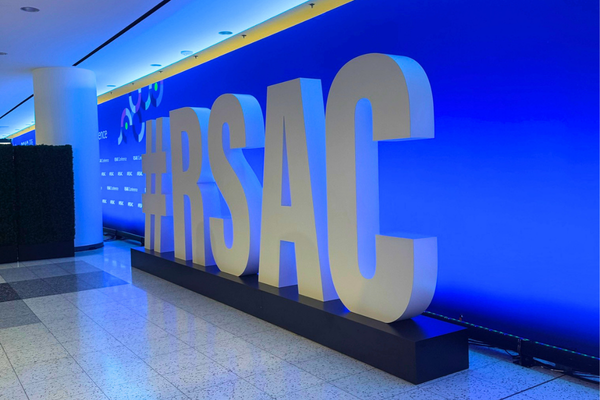
Walking the RSAC Expo Hall, the feeling hit immediately: a sense of déjà vu. AI dominated the show floor this year, appearing at the center of nearly every vendor’s booth. As a result, brands blurred together, with similar claims and language making it difficult to differentiate one company from the next.
This year, the Highwire team analyzed the messaging displayed across booths throughout the Expo Hall, aiming to quantify what the industry is saying, how those narratives are being framed, and where real white space for differentiation exists.
To go even deeper, Highwire’s Insights & Analytics team used AI tools to analyze booth imagery from companies that sponsored RSA Conference this year, measuring the prevalence of recurring themes and language. The result is a data-driven view of the narratives dominating the cybersecurity conversation.
AI Isn't Enough Anymore
The data reveals a stark reality about industry lexicon. AI has firmly cemented its place as the dominant narrative, moving from an emerging trend to a foundational expectation.
The team uncovered that nearly half (45.7%) of all booths analyzed featured "AI" or "artificial intelligence" front and center. When almost half the floor is leading with AI, simply having AI capabilities is no longer enough to stand out. The true differentiator will be how companies articulate the specific value and outcomes their AI technology delivers.
We've seen this before with "Zero Trust." Once the defining rallying cry of the industry, the term appeared on just 6.2% of booths this year. This suggests that Zero Trust may have transitioned from a marketing buzzword to an assumed architectural standard that no longer requires prominent real estate on booths.
AI is on that exact same trajectory. The brands that recognize this will be the ones that define what comes next. Emerging terms like "agentic" (9.9% of booths) and "resilience" (8.6%) are gaining traction but haven't hit saturation.
How companies choose to lead their messaging reveals their broader market strategy. It’s critical for brands to act now to own their AI positioning and break the mold.
Break Out of the Sea of Sameness
The conformity problem runs deeper than any single buzzword. When we plotted the companies on a differentiation matrix of messaging originality and creativity, the vast majority clustered in the same lower-left quadrant. Safe messaging. Safe design. Maximum invisibility.
The conformity matrix makes it stark: 22.2% of the floor deployed the exact same combination of AI-centric messaging and a blue-dominant color scheme. Nearly half the floor (45.7%) used blue as their primary color. Looking at positioning themes across companies found a messaging overlap of 50% or higher.
The booths that broke through did one of two things: They either paired aspirational positioning with a specific, verifiable claim, or they went the opposite direction entirely with a punchy, attitude-driven tagline that communicated brand personality.
The data points to a clear set of moves for cybersecurity brands heading into any major industry event.
- If you're leading with AI, get specific. A measurable outcome, a named capability, a concrete use case. The category claim alone is no longer enough.
- If your booth is blue and your headline mentions AI, you are statistically indistinguishable from a quarter of the floor.
- Ground your claims in reality. Less than a fourth of booths paired technical messaging with actual product screenshots. In an industry plagued by vague promises, visible proof is one of the clearest differentiators available.
Make your brand memorable, not just visible
The data is clear: big budgets get you seen, but a sharp point of view is what makes you memorable.
At Highwire, this kind of intelligence defines how we help clients show up—not just on the show floor, but across earned media, content. social, and creative. If you’re thinking about how your brand shows up at major industry events – and how that resonates with key audiences – get in touch to ensure you stand out, not blend in, at your next big moment.
.png)