
Every year, RSAC reflects the state of cybersecurity. But the more valuable signal isn’t what appears on the agenda — it’s how the agenda compares to where the broader market is focused.
Attention in cybersecurity is not evenly distributed. Some themes carry sustained media and executive attention yet fail to dominate conference programming. Understanding that imbalance is where real narrative advantage lives.
Highwire’s Insights & Analytics team analyzed RSAC 2026 session topics alongside 90 days of cybersecurity media coverage and industry conversation. The objective was not to critique the conference, but to identify where attention is saturated, where it is underleveraged, and where security brands have room to differentiate before the narrative calcifies. The data reveals clear patterns of ripe opportunity
AI Is the Most Saturated Narrative
205 sessions at RSAC 2026 will focus on AI and security. The next largest category, leadership and organizational strategy, accounts for 70 sessions. Identity management has 20 sessions. Geopolitics has 18. Quantum and encryption have 11. AI does not simply lead the agenda. It overwhelms it.
Media coverage, however, is more distributed. Over the past 90 days, we found:
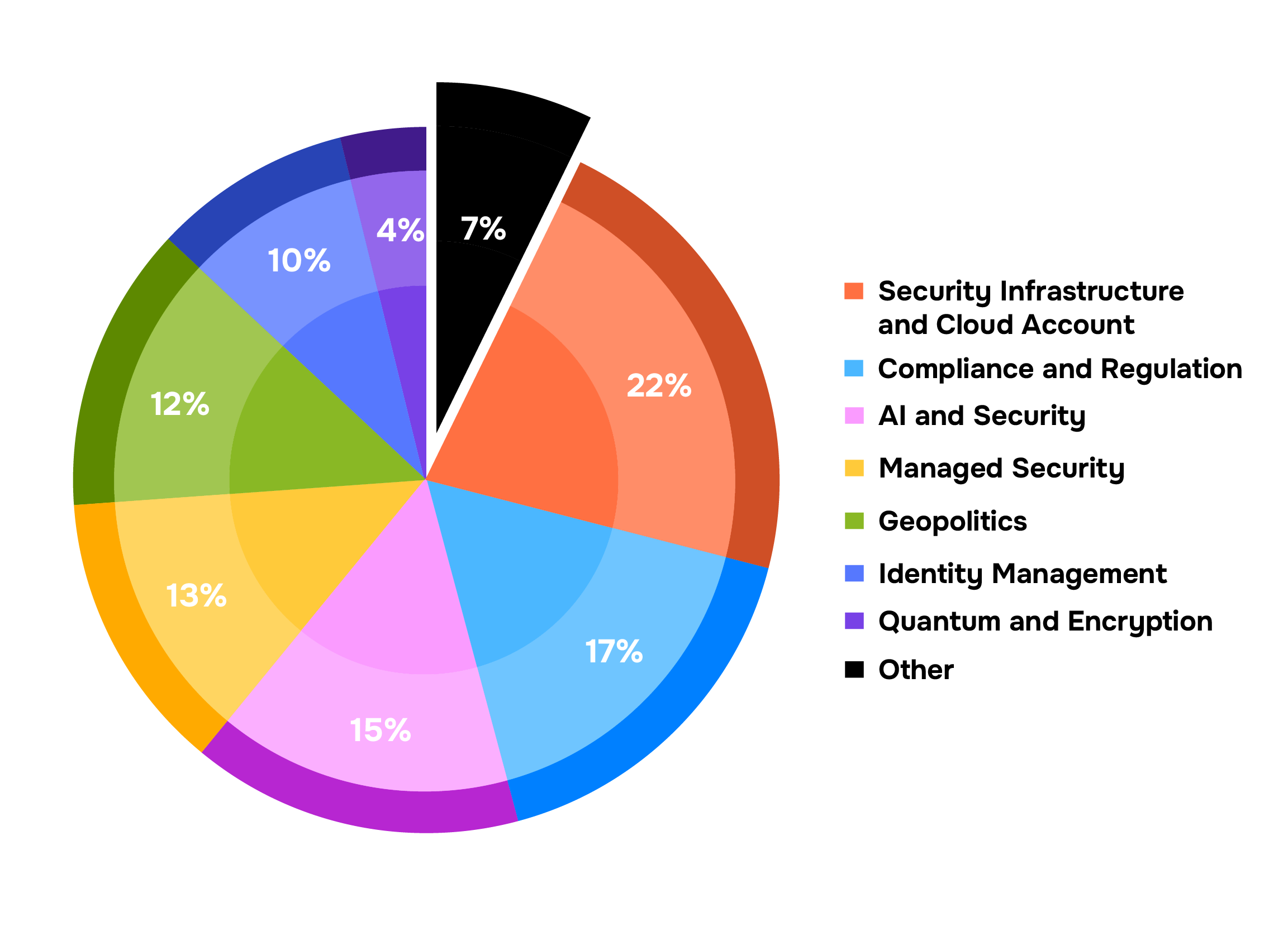
AI is influential, but does not dominate the broader market conversation the way it does in RSAC programming. When a theme becomes this concentrated, generic messaging fades into the background. “AI-powered” is no longer a differentiation; it’s a market expectation. The strategic question is not whether to talk about AI. It is where you compete inside it.
The Underplayed Opportunity Lives in the Implications of AI
With AI occupying more than half of RSAC’s programming, simply leading with AI isn’t enough — everyone will be doing that. Where you can command attention is in the implications of AI adoption: how it reshapes identity models, governance structures, operational risk, and the economic pressure inside security organizations.
That is where fewer vendors are competing. And that is where attention can be claimed.
Three areas, in particular, stand out as strategically underplayed relative to their sustained media weight and executive relevance:
- Identity as the enforcement layer: Identity accounts for 10% of media coverage, yet represents a fraction of RSAC programming. As machine and non-human identities proliferate, governance shifts from authentication to authorization, access control, and agent oversight. Brands that anchor their AI story in identity governance will differentiate within a saturated category.
- Geopolitical resilience as a board-level narrative: Geopolitics represents 12% of coverage, but receives a comparatively less formal spotlight at RSAC. Supply chain exposure, regulatory fragmentation, and nation-state risk continue to shape executive priorities. Vendors that connect their positioning to operational resilience will resonate beyond technical sessions.
- Security economics and consolidation pressure: Compliance and regulation account for 17% of media coverage, while 70 RSAC sessions focus on leadership and organizational strategy. Security leaders are being asked to rationalize spending and prove ROI. Innovation without economic clarity will struggle to break through. These themes are not peripheral. They are simply less saturated than AI as a headline.
What This Means for Security Brands
This is not about whether RSAC is aligned with the market. AI deserves its prominence. The insight lies in concentration.
AI is crowded. Identity governance, geopolitical resilience, and security economics are comparatively under-leveraged. Smaller categories, such as quantum, signal, long-term maturity, rather than immediate volume. RSAC shows where the industry is loud. Media coverage shows where the market is listening. The brands that win in 2026 will not chase the loudest narrative. They will choose where to compete with intention, owning the governance, resilience, and economic implications beneath the AI headline.
If you want to explore how a data-driven approach can help refine your RSAC strategy and connect you with the right audiences at the right time, let’s talk. We’d love to meet you at RSAC.
— Hannah Klaassen, #HWCyberSquad
.png)