New analysis of more than 8,000 news stories reveals a lasting shift in private credit coverage, growing scrutiny of private equity, and the executive strategies gaining ground amid market uncertainty.
SAN FRANCISCO & NEW YORK - October 27, 2026 — Highwire, a leading integrated communications and marketing agency, today released What Comes After the Cockroaches?, a new research report examining how heightened scrutiny of private credit has fundamentally changed the media landscape for private markets firms and financial services leaders.
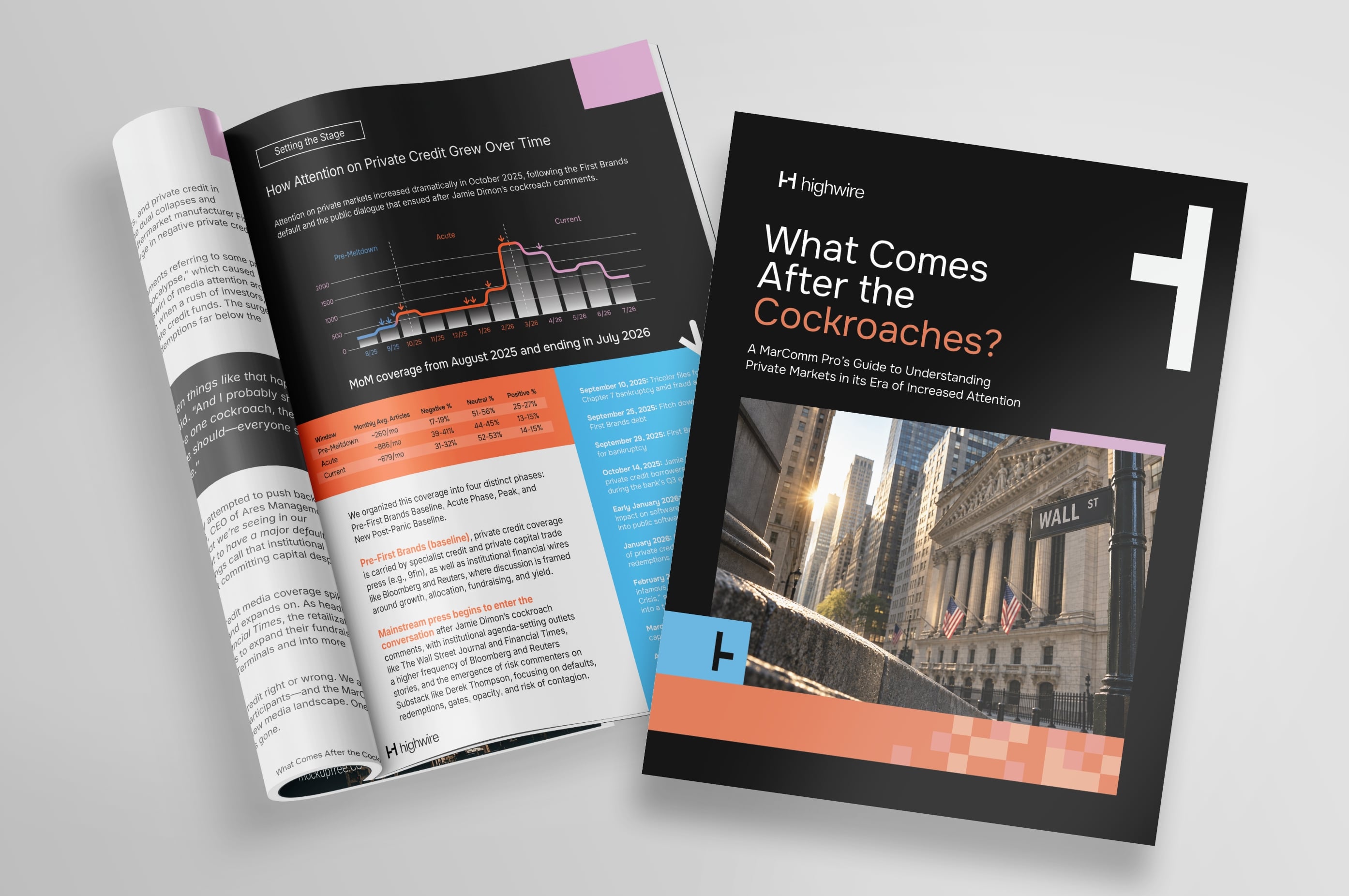
Analyzing more than 8,000 distinct private credit news stories from August 2025 through July 2026, the research finds that media attention has established a new baseline following the collapse of First Brands and Tricolor, subsequent concerns over software valuations, and a wave of private credit fund redemption requests. While coverage has retreated from its March 2026 peak, it remains more than three times higher than pre-crisis levels, with negative sentiment accounting for nearly one-third of current coverage.
The findings point to a sustained change in how private markets are covered, with implications extending beyond private credit to private equity, wealth management, investment banking, and the broader financial services ecosystem.
Key Findings: A New Baseline for Private Markets
- Private credit coverage remains more than 3X its pre-crisis level. Monthly coverage averaged approximately 260 articles before the September 2025 failures, compared with 879 articles per month from April through July 2026.
- Negative sentiment has become more persistent. At the height of the crisis in March 2026, coverage reached 2,217 articles, seven times its previous monthly baseline, with 51% classified as negative. Even as attention eased, negative coverage remained at 31%, compared with approximately 19% before the crisis.
- Private equity is increasingly absorbing the scrutiny. Private equity's share of negative private-credit-adjacent coverage increased from 10.8% at the beginning of the crisis to 15% in the report's latest analysis, reflecting growing attention to portfolio valuations, leverage, and exposure to distressed borrowers.
- Executive positioning can materially influence the narrative. Leaders who provided credible market interpretation and forward-looking perspectives achieved markedly different media profiles. Ares Management CEO Michael Arougheti, for example, saw the negative share of his analyzed coverage decline from 48% during the acute phase to just 1% in the post-panic period.
- Influence and positive sentiment are not synonymous. JPMorgan Chase CEO Jamie Dimon's widely cited warnings helped shape the broader market conversation, demonstrating that an executive can establish authority and influence even when appearing in negatively framed coverage.
"The private markets conversation has fundamentally changed. Financial institutions can no longer rely on the communications strategies that worked when growth and returns dominated the narrative. Organizations that can credibly explain risk, demonstrate resilience, and help audiences make sense of market complexity have an opportunity to build lasting authority." said Greg Hassel, Executive Vice President, Financial Services, Highwire.
The Next Challenge: Establishing Credibility in a More Scrutinized Market
Highwire's findings show how private credit coverage expanded beyond specialist financial publications into mainstream business and consumer-facing media, bringing questions of risk, liquidity, transparency, and investor access to a wider audience.
The report also examines how senior financial executives navigated this shift, identifying distinct approaches to establishing authority. Leaders such as Oaktree's Howard Marks and Goldman Sachs' David Solomon demonstrate the value of consistent market education and strategic interpretation, while executives at firms more directly associated with private credit illustrate how constructive narratives can emerge following periods of intense scrutiny.
These findings have implications for financial institutions across the private markets ecosystem. The research outlines tailored communications opportunities for asset managers, private equity firms, investment banks, advisors, exchanges, data providers, and wealth managers, recognizing that each faces different reputational challenges and business priorities.
With no single recovery narrative yet established, Highwire identifies an opportunity for organizations to define their positions through evidence-backed messaging, executive visibility, thought leadership, and integrated communications strategies aligned with their business objectives.
About the Research
What Comes After the Cockroaches? A MarComm Pro's Guide to Understanding Private Markets in its Era of Increased Attention was developed by Highwire's Financial Services and Insights & Analytics teams.
The research draws on seven searches encompassing nearly 70,000 news records across private credit, direct lending, and related financial services sectors. Its central analysis examines 8,298 distinct private credit stories published between August 2025 and July 2026, alongside executive media coverage and sentiment analysis, to identify shifts in market narratives and the communications approaches most relevant to financial services organizations.
Download the full report: https://www.teamhighwire.com/insights/what-comes-after-the-cockroaches
About Highwire
Highwire is an integrated communications and marketing agency partnering with organizations to build reputation, establish market authority, and accelerate business growth. Combining senior strategic counsel, industry expertise, creative thinking, and proprietary technology, Highwire helps clients navigate complex markets and turn innovation into measurable impact.
Learn more at teamhighwire.com.