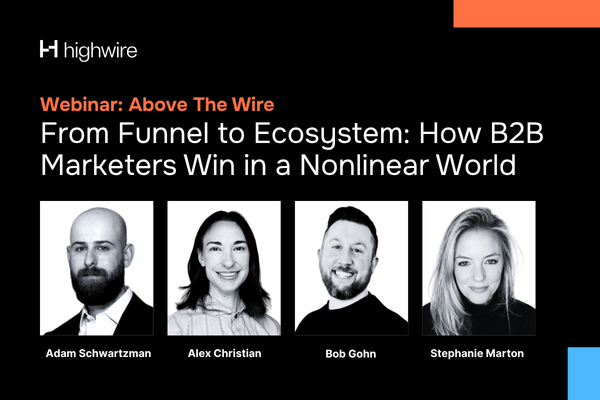
On Tuesday, June 23rd, Highwire hosted a webinar titled “From Funnel to Ecosystem: How B2B Marketers Win in a Nonlinear World.” The expert panel, including Adam Schwartzman, SVP, Content, Alex Christian, SVP, Insights and Analytics, Bob Gohn, SVP, Integrated Marketing, and Stephanie Marton, SVP, Influencer Marketing, discussed how marketing is evolving amid AI, shifting buyer journeys, and new standards of measurement.
Watch the full webinar and hear directly from the conversation here:
The short answer is that no, the marketing funnel from awareness, to consideration, to decision is not dead. But it is not useful to understand the buyer’s journey as a linear path, but more so as an ecosystem or cycle. A customer may become aware of an issue but spend a lot of time learning and researching possible solutions before becoming ready to buy.
Even when a buyer converts, that is not the end point, but just the beginning. At the point of conversion, competitors may begin to target your customer, causing them to possibly doubt their decision. Therefore the consideration stage does not take place before conversion only, but also after. After conversion, your business must deliver value and service that turns that conversion into a longstanding customer, advocate, and peer-to-peer recommender.
“The marketing funnel was never a linear journey in the first place. The way I use the funnel is as a map or a field when approaching content strategy. By asking who our audience is and what they care about - you can uncover the questions they might ask and respond with the appropriate content.”
Adam Schwartzman, Senior Vice President, Content
Understanding your audience in the marketing ecosystem
To design a marketing ecosystem that is successful at not only driving conversions but champions, marketers need to know what their audience needs - not make assumptions. This means understanding what made a new conversion say “yes,” as well as why long standing customers continue to come back. The goal should be: “how can we get more customers to say ‘yes’ and how can we shorten the timeline to a ‘yes.’” Direct interviews and surveys are incomparable for revealing insights. In addition, most companies are swimming in data. For most companies, the problem is not that they do not have enough data, but that they are not analyzing it and not using it to inform their marketing strategy.
That is where AI can play a role. At Highwire, we develop AI audience models. These models are trained on real data from real buyers, but allow us unlimited queries of the model, where as focus groups can be expensive and limited. An audience model allows marketers to fully utilize their customer data and tweak their strategies in real time based on new insights.
Through research, a marketer can understand why a new customer says “yes,” but the reasons behind the “yes” may look different for each client. By building buyer personas and using those personas to inform each AI audience model, marketers can understand how different personas react to different marketing campaigns and messaging.
In addition to owned customer data and insights, another great resource for understanding your audience is influencer partners. Influencers may be able to share insights into your audience that you do not have, particularly at the awareness level. They may also be able to share ways to communicate with your audience in an authentic way.
“We have access to so much data now that we can get very, very close to understanding exactly why our target audience says yes, and that is all we really need to go back and work on a comms strategy. If we know why people say yes, then we should develop strategies that enable us to get to that yes as quickly, easily, and confidently as we can.”
Alex Christian, Senior Vice President, Insights and Analytics
Defining and measuring success
Digital marketing is defined by metrics like click-through-rates, cost-per-click, open rates and unsubscribes. But as the buyer’s journey evolves from a linear path to an ecosystem, these metrics may not be defining the true value marketing and PR efforts are bringing to your business. Instead, consider how you can measure the full value of marketing campaigns. Marketing influences brand perception, talent pipeline, and nature of customer service inquiries and engagement. For example, content campaigns can increase customer awareness of product features and therefore reduce customer service inquiries. While it may be more difficult to track the holistic influence of PR and marketing on the business, it can be achieved through social listening, customer and talent surveys, brand lift studies and more.
Today, many buyers discover and consider purchases entirely within AI chat bots, meaning, metrics like website traffic and time on page are no longer providing a full picture into how your brand reaches audiences. Measuring how your brand appears in AI search and chat results, as well as the associated sentiment is a critical metric to track in this new buyer ecosystem.
“Historically, the first purchase was treated as the finish line. But that’s just not how people engage with brands today. Digital media has evolved into a much more interconnected ecosystem where commerce, social platforms, creators, and communities all overlap. Customers are constantly discovering, researching and then reengaging with brands across multiple touchpoints.”
Stephanie Marton, Senior Vice President, Influencer Marketing
the importance of integrated marketing in today's buyer ecosystem
The reason why the “marketing ecosystem” is a more accurate description of today’s buyer’s journey is that so few buyers have a linear journey. They may have heard about your product on a podcast ad, read an article mentioning your product, had a conversation with a colleague who has used your product, saw a digital ad for your product, learned more about your brand in an AI chat conversation, and downloaded an ebook from your website. And they may still not be ready to buy. This is not a linear path to conversion but a network of touchpoints with your brand.
The job of marketers is to maximize the number of positive touchpoints a potential buyer has with your brand. Show how your brand understands their unique needs and how you can be a partner in their success. By optimizing for your brand’s reputation, influence, and awareness among key audiences, you will find that audiences in your marketing ecosystem “funnel” themselves into buyers.
“We need to keep conversations and communications between marketing and communications teams open. The real-time pitch angles that PR is using to drive thought leadership are angles that could inform content down the road. Meanwhile, influencer partnerships could provide valuable insights into your audience and paid campaigns could reveal audience behavior. PR, content, paid, and influencer marketing should all fuel each other.”
Bob Gohn, Senior Vice President, Integrated Marketing
a marketing ecosystem, built to deliver
If you're ready to move beyond the funnel and build a true marketing ecosystem, Highwire can help. Our experts craft consistent messaging across every channel and touchpoint, backed by data that shows what's actually driving your audience to say yes. Contact us today to start building influence that turns customers into advocates.