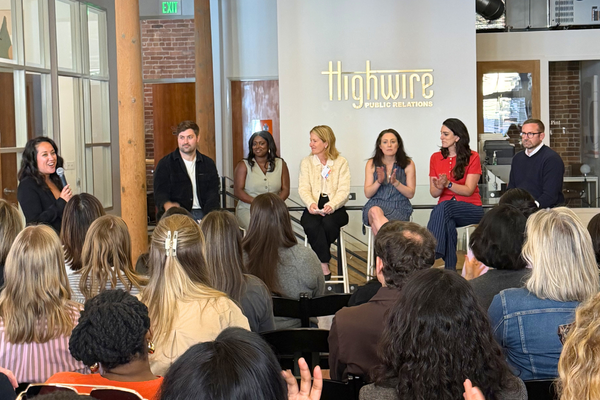
As AI reshapes what it means to communicate, the most pressing question for senior comms leaders has shifted from tool capability to human irreplaceability. At our recent panel event, Highwire brought together senior communications leaders for an intimate conversation on influence, brand differentiation, and the human skills that no algorithm can replace.
The room included Melissa Marasco (Head of Brand, Consumer & Product Communications, Lyft), Heather Dickinson (VP of Communications, Cisco), Randa Hinton (Head of AI Industry Thought Leadership, NVIDIA), Jesse Dwyer (Chief Communications Officer, Perplexity), and Amanda Coffee (Communications and PR Leader, Coffee Communications), moderated by Alex Konrad, Founder of Upstarts Media.
One theme ran through every conversation: the communicators who will lead in the next decade will be defined by several things much harder to replicate.
1. Curiosity Is the Human Skill That Will Always Be in Demand
As AI commoditizes execution, the leaders who build resilient teams will be the ones hired for intellectual hunger over technical proficiency.
"I'm gonna bring it all down to one word: curiosity," said Heather Dickinson, VP of Communications, Cisco. "The single thing that, throughout decades of trying to build successful teams, I'm always looking for — are you hungry? Are you curious? Are you asking questions?"
Curiosity functions as the primary filter on any great team, and it shows up long before someone lands the job. Strong teams are built on people who are hungry to experiment, willing to be wrong, and relentless about staying current. Melissa Marasco, Head of Brand, Consumer & Product Communications at Lyft, holds herself to the same standard: "I expected myself to stay current, to ask questions, to be curious, and I expect early-in-career people to ask questions, to be curious, and that symbiotic relationship — we learn from each other — that defies AI."
"AI will be a tool, but you have to stay curious." – Heather Dickinson
2. Understanding What People Need and Why
What a senior comms leader carries into any situation — a board meeting, a crisis, a difficult media cycle — is the ability to read the room and respond, which is a judgement call AI can’t make.
"One of the things that I really like to bring to my communications practice is just a basic understanding of human psychology," Marasco said. "And I think that's something that you will never be able to outsource."
Jesse Dwyer, CCO at Perplexity, made the operational case plainly: "A set of principles is really the only way to do that. You just have to have the rules." Strong principles are what let you walk into a crisis without losing your footing, while everyone else scrambles to figure out where they stand. Leaders who handle uncertainty well are working from an internal set of guidelines they developed long before the pressure arrived.
"AI makes the importance of humanity even more important." — Melissa Marasco
3. Knowing When to Lead and When to Step Back
In a landscape where AI can generate content, automate distribution, and optimize messaging, the decisions that actually move organizations forward are the ones no model can make: who leads, who defers, and what the work is ultimately in service of.
Randa Hinton, Head of AI Industry Thought Leadership at NVIDIA, distilled it to a single principle her team lives by: "The mission is the boss. What is the mission? What's the objective we're trying to achieve? And then we work as one team. I might have come up with the idea, but that doesn't mean that I'm the best person or the best team to lead the mission." That kind of judgment of understanding when to lead and when to step back is a deeply human capability. It requires reading organizational dynamics, managing ego, and keeping outcomes above ownership. No prompt engineers that.
"The mission is the boss." — Randa Hinton, NVIDIA
4. Enthusiasm, Authenticity, and a Unique Voice
As employee-generated content becomes a legitimate brand channel, the question for senior comms leaders is whether their organization has the infrastructure and cultural permission to scale it without losing narrative control.
"The brands that find a way to really encourage internal entrepreneurism and telling the brand story — that might be one of those jobs that, with how AI's going, is a new job that didn't exist before," said Amanda Coffee, Communications and PR Leader, Coffee Communications
Marasco described Lyft's approach as inside-out storytelling: a toolkit of approved assets paired with genuine trust in employees to share authentically. Jesse Dwyer's operating principle was direct: "Just don't fire people when they screw up. Have a conversation with them, and then everybody gets a better sense of what’s in bounds." Brands that get this right will build enough psychological safety for their people to show up as genuine advocates.
"Just because it was done one way doesn't mean it has to be done like that forever." — Amanda Coffee
There Has Never Been a More Important Time to Be a Communicator
Across every conversation, one point held: AI is extraordinarily good at the system. What it cannot replicate is the leader who knows when to break from it — who reads the room, builds the right team, earns the trust, and makes the call.
The communicators who define the next decade will use AI to do more of what only humans can do, and build organizations capable of doing the same.
To learn more about how Highwire is approaching the new age of AI, check out our AI Maturity Model, AI Index, and AcroAI.
.png)